



How Image Optimisation and Delivery Support GEO and AEO
Search is changing faster than other areas of strategic marketing The question used to be: can Google find and rank your content? Now there's a second question, and it matters just as much: when an AI engine generates an answer, does it cite you?
That shift is what sits behind two terms you're start hearing more often, of you're not already: GEO (Generative Engine Optimisation) and AEO (Answer Engine Optimisation). Both describe the same underlying challenge: to make your content easy for AI-powered search tools to find, understand, and surface with confidence.
Currently, most teams are approaching this as a writing problem. Fix the copy, add structured data, build topical authority, and AI powered tools will find and reference you. But there's an important layer almost everyone overlooks: your images.
How visual assets are optimised, named, tagged, and delivered has a direct bearing on how quickly your pages load, how well crawlers read them, and how confidently AI engines cite them. In this article we'll unpack why this happens, and what an improved GEO/AEO workflow can look like in practice.
What GEO and AEO actually mean, and why they matter
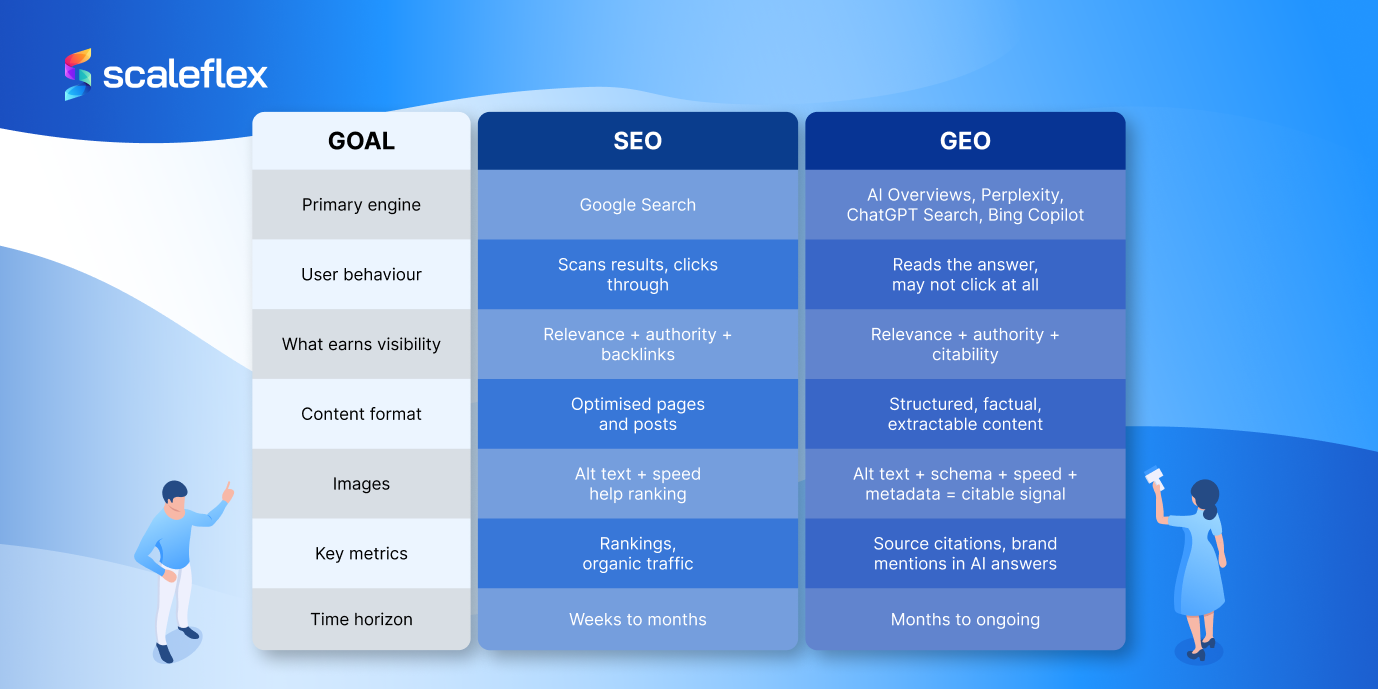
For the better part of two decades, SEO has meant one thing: earn a top position in a list of links. Users would scan the results, pick one, click through. Your job was to be the most relevant result in that list. That model is still very much alive, but the landscape has become a little more complex.
AI-powered search tools, like Google's AI Overviews, Perplexity, ChatGPT Search, Bing Copilot, are increasingly generating direct answers rather than lists of links. A user asks a complex question and gets a synthesised response, pulled from multiple sources, delivered in one place, with no extra clicks required.
GEO (Generative Engine Optimisation) is the practice of making your content more likely to be used as a source in those generated answers. AEO (Answer Engine Optimisation) is closely related to it, but it focuses specifically on structuring your content so it can answer a discrete question clearly and completely, in a format that's easy to extract.
While neither replaces traditional SEO, you should think of them as an additional layer; one that's becoming harder to ignore as AI-assisted search grows in everyday use across your target audience.
The exact ranking logic behind AI-generated answers is not public, and it varies by platform. But the patterns are consistent enough to act on. In general, AI favors content that is:
- Fast to load: slow pages get crawled less frequently and trusted less
- Structurally clear:logical heading hierarchy, well-labelled sections, machine-readable markup
- Factually specific: named entities, numbers, dates, certifications, and client references that an algorithm can anchor to
- Visually well-structured: images with meaningful alt text, proper schema markup, and consistent metadata
That last point is where most content strategies have a blind spot. Visual assets are not passive decoration. They are data and right now, most of that data is either missing, inconsistent, or invisible to the engines that matter.
Why images are an underestimated GEO/AEO signal
When a crawler lands on your page, it doesn't read it the way a human does. It processes the whole thing, the HTML structure, load behaviour, metadata, linked assets... before it forms a view of what the page is about and how much to trust it.
Images are a crucial part of that first impression. A page with five uncompressed images that take four seconds to load is, from a crawler's perspective, a slow and poorly maintained page. It gets crawled less often. Its content gets weighted less confidently. And in a GEO context, where AI engines are looking for sources they can cite with authority, a technically weak page is quickly deprioritised, regardless of how good the writing is.
Page speed is a ranking signal in traditional SEO. But in GEO, its role is arguably more significant: AI engines are not just assessing relevance, they're assessing reliability. A fast, clean, well-structured page signals that someone is actively maintaining it. That matters when an algorithm is deciding whose answer to put in front of millions of users.
Topical authority, which is the idea that a domain is a credible, comprehensive source on a given subject, is one of the clearest patterns in how AI engines select sources. The more thoroughly and consistently you cover a topic, the more likely your content gets pulled into generated answers.
That's why an image with a descriptive filename, accurate alt text, and relevant schema markup is a piece of structured content. It reinforces the topic of the page. It adds a layer of semantic signal that crawlers can read independently of the text around it. Multiply that across hundreds or thousands of product pages, editorial articles, or landing pages and the cumulative effect on your topical footprint is rather significant.
The inverse is also true. A site where images are named DSC_4471.jpg, carry no alt text, and live outside the main domain is actively working against its own authority.
How your content delivery pipeline can feed GEO signals
Every image in your ecosystem carries data beyond its pixels: a filename, a creation date, a title, keywords, usage rights, format, dimensions. This is metadata and often times, it is either incomplete, inconsistent, or locked inside a system that doesn't talk to the rest of the stack, creating fragmentation that can directly impact GEO.
AI engines build their understanding of your content from signals accumulated across your entire web presence. When the same product appears under three different filenames on three different pages, that signal is diluted, the crawler sees inconsistency, and the AI engine sees a source it can't fully trust.
A digital asset management platform fixes this at the root. When every image is ingested through a single pipeline, naming conventions are enforced once and applied everywhere. Metadata is captured on upload and stays attached to the asset wherever it's used. The result is a content inventory that speaks with one voice to every crawler that touches it. Consistency like this at scale is a competitive advantage, since most oganisations haven't built around it.
For many companies, metadata is entered manually, generating bottlenecks taht degrade content strategies. Teams that are uploading
200 images a week and relies on contributors to fill in metadata manually will, within months, have a catalogue where half the assets are partially tagged and a quarter carry no useful metadata at all.
Most asset management services will offer some kind of AI-powered tagging models that can analyse images un upload to generate descriptive tags, suggest alt text, identify objects, and more. This carries real SEO and GEO implications, since a fully tagged asset is a fully indexed asset, which is in turn, a citable source! When this process is happening automatically across all your images, the cumulative effect on your topical footprint is compounding.
For GEO specifically, these things matter because AI engines are building a model of your domain's credibility and scope. A coherent, consistently structured delivery architecture and metadata tagging is a signal of a wellmaintained, trustworthy source. While it won't make a weak page rank, it can remove a layer of technical noise that, at scale, could be working against you.
What an AEO ready workflow looks like in practice
The gap between knowing what good looks like and actually having it in place is, for the most part, an operational one. The principles covered in this article are not contested. The challenge is building a workflow where they happen consistently, without adding friction to the people managing content day to day.
An AEO-ready image workflow is not a checklist, it's a pipeline where the right things happen by default, and it starts at ingestion. When an asset enters the system it passes through an automated layer that applies naming conventions, triggers AI tagging, scaffolds alt text based on available metadata, and assigns the file to the correct folder structure. The asset arrives in the catalogue already partially optimised.
From there, delivery is handled centrally. The CDN serves the appropriate format and resolution based on the requesting device and browser (WebP, AVIF, or a fallback JPEG) without anyone making that decision manually. Structured data is generated from the asset's metadata and applied at the point of publication. The image sitemap updates automatically.
The result is a content operation where image optimisation is not a separate workstream, but the default output of doing things in the right order, with the right infrastructure underneath. To make this concrete, here is what a fully optimised image looks like from an AI engine's perspective, and what your workflow should be producing, at scale, without manual intervention for each asset:
- Descriptive filename: human-readable, keyword-relevant, consistent with the naming convention applied across the catalogue (womens-merino-jacket-ss26-midnight-blue.jpg, not IMG_4471.jpg)
- Accurate, specific alt text: describes what the image shows, reinforces the topic of the page, avoids keyword stuffing
- Relevant schema markup: ImageObject at minimum; Product or Article where appropriate, with fields populated from existing asset metadata
- Fast load time: served in the lightest format the browser supports, sized appropriately for the context, delivered via CDN served in the lightest format the browser supports, sized appropriately for the context, delivered via CDN
- Canonical URL: one address, one domain, no duplicates across platforms or upload locations
- Image sitemap entry: indexed cleanly, updated when the asset changes or is retired
- Topical consistency: the image metadata, alt text, and surrounding content all reinforce the same subject matter, rather than pulling in different directions
No individual item on that list is technically demanding. The challenge is producing all of them, for every image, every time. That is the infrastructure problem that separates organisations with a compounding GEO advantage from those perpetually catching up.
Key takeaways
GEO and AEO are not separate disciplines bolted onto your existing content strategy. They are the result of doing the fundamentals well, and images are a bigger part of those fundamentals than most teams realise.
AI engines assess page quality before they assess content quality, and a slow, poorly structured page loses before the writing is even evaluated. As part of the page quality assesment, images are structured data that send signals to crawlers and AI engines. Providing consistency at scale is the real differentiating element. Thousands of optimised images pose a compounding advantage for GEO and AEO optimisation.
Organisations already treating their visual content pipeline as a GEO asset are building an advantage that will be hard to close. The good news: the technical foundations are not complicated. They just need to be in place and working by default, not by exception.