


Modern Content Supply Chain: A New Era of Smart Automations
Nowadays, visuals are the drivers of brand perception, product discovery and user experience. The way content flows through an organization is more than an operational concern as it becomes a strategic imperative. From the point of ideation to distribution, every single image, video and graphic needs to go through a journey that will involve multiple teams, tools and touchpoints. That journey is called the content supply chain.
As volumes and speed of content keep growing, the cracks in the system do so too: assets become scattered, approvals stall and formats multiply. Without a clearly structured pipeline, marketing starts slowing down and the quality of the content suffers.
Teams that are forward-thinking are already treating content in the way a manufacturer would treat its products: with structured workflows, intelligent automations and performance monitoring. In this article we’ll explore how modern digital content supply chains can help our businesses operate with more agility, creativity and control, possibly unlocking the full range of potential of their assets.
From silos to systems: the evolution of content operations
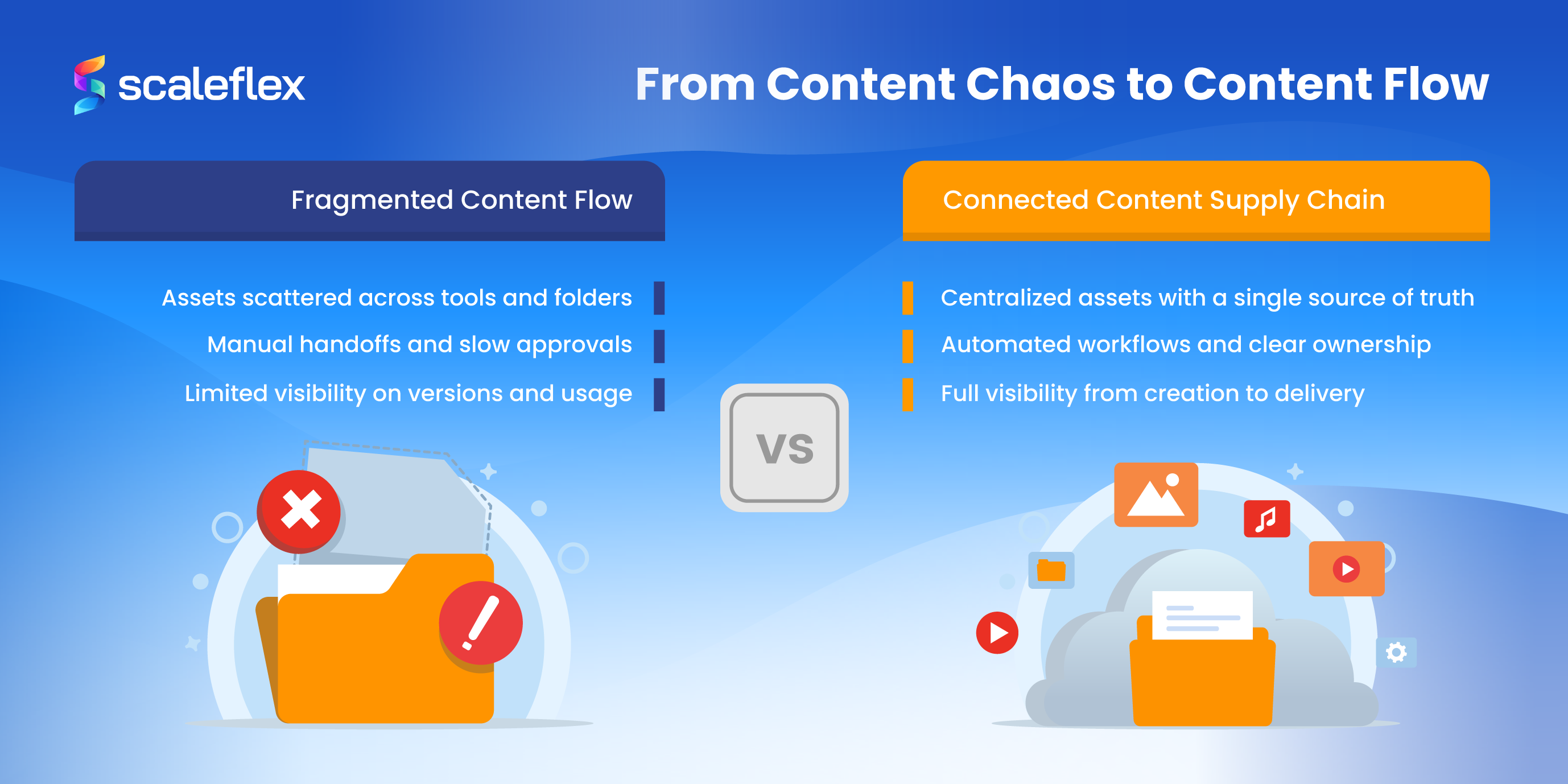
Not that long ago, content workflows were barely more than patchworks: scattered folders, endless email threads, manual approvals and assets being stored across different tools and even teams. These fragmented systems may have worked back when the content demands were modest. But today, with the demand of delivering personalized content and omnichannel experiences at scale, that old way simply won’t hold up.
The shift in content demands has exposed an essential problem, which is that most businesses are treating content creation and delivery as isolated tasks instead of as part of a larger, connected system. As a result, they’re struggling with duplicated efforts, inconsistent branding, missed deadlines and ever-growing and chaotic asset libraries.
Our modern content needs require a rethink. Content supply chains must function almost like supply chains, where content moves efficiently from one stage to the next, enriched and optimized along the way. It means breaking down silos and connecting every single component of the workflow: from the creation and storage of the asset, to optimization and multichannel delivery.
If we dive into content supply chain automations, composable architectures and MACH Alliance based technologies come into play. As they’re built on principles of modularity, API-first design, cloud-native infrastructure and headless flexibility, they can allow teams to integrate the tools they need and quickly evolve without overhauling everything.
Marketers and IT leaders have the opportunity to unify their tools and teams through a connected ecosystem through which content easily moves. With the right structures in place, content can be easier to manage and even become a competitive advantage.
Core building blocks of a modern content supply chain
At its core, a content supply chain strategy revolves around coordination. Its goal is to move content as smoothly as possible from creation to delivery, without any delays, confusions or waste. To do so, it needs a few foundational elements to be set up in advance.
First and foremost, a single source of truth for assets, whether that be a DAM solution or another structure system. This is a non-negotiable, as teams can’t afford to waste time digging through endless folders or second-guessing which versions are finalised and approved.
Then, you need clear roles, ownership and workflows. Who’s creating the content? Who approves it? Who will adapt it for local markets or formats? Without this essential clarity, even the best tools won’t be able to prevent bottlenecks.
Thirdly, metadata and taxonomy matter way more than most people think. Without consistent tagging and categorization, content quickly becomes unsearchable and underused, particularly at scale.
Then there’s optimization for delivery, which doesn’t exactly mean flashy features, but rather understanding where your content will live (web, email, retail screens) and ensuring its format and size are ready for each environment.
Finally, your distribution needs structure too, as sharing content with internal teams, partners or agencies can quickly turn into endless emails and file links. A shared workspace, portal or automated delivery pipeline can ensure seamless and controlled access to assets.
A well-functioning content supply chain is less about buying the “right stack” and more about designing a system where people, processes, and platforms are actually working together.
Real world friction: what slows down content supply chains?
Even with the best of tools and intentions, a content supply chain strategy can still suffer from some form of friction. Problems aren’t always obvious at first, but over time they start showing up as slow campaigns, duplicated work or content that never sees the light of day.
Disconnected teams and workflows are a main major issue. As creative, marketing and product teams often use different systems, with differing timelines and priorities, feedback loops are fragmented, context goes missing and progress stalls. This is when assets can easily get lost or forgotten.
Manual tasks also present a threat. If your single source of truth relies on manual tagging, and you do a lot of renaming and copy-pasting, across large volumes of content, this creates a real drag, increasing chances of errors such as publishing outdated images or breaching usage rights.
Poor visibility is a common recurring pain point, as many teams lack answers to the most basic questions: what content exists? What’s been approved? What’s being used, and where? Without this base-level visibility, teams risk re-creating content they already have, or hesitating to use an asset simply because they’re unsure of its status.
In the end, content distribution appears as an afterthought. Getting the content to the people who need it (sales reps, regional teams, external partners) often ends up being email-based and overly reliant on that one person in the team who “knows where everything is”.
The fixes, most of the time, are simple. They just require a bit more forethought to build leaner, error-proof systems and processes.
Designing a resilient and scalable content supply chain
There are a few key principles that make all the difference between a fragile system and one that can scale with you:
- Clarity and alignment: map out how content is moving through your organization, who’s involved, what tools are being used and where the delays are happening. Without this visibility, it’ll be impossible to prove anything. A basic audit can often reveal misalignments between teams, and the gaps where content is getting stuck or duplicated.
- Standardize everything that can be standardized: naming conventions, approval flows, tagging, format specifications. These small agreements can remove ambiguity and make collaboration faster. In global teams, these “rules of the road” are what can keep things from slipping through the cracks. If your single source of truth or DAM provider includes AI capabilities flagging duplicates, tagging and formatting become an increasingly smooth and simple process.
- Governance: set up your permission models and content usage guidelines, including expiry rules that will protect your brand, but without creating unnecessary roadblocks. The goal should be to balance control and security with speed and easy access.
- Feedback loops: what content is actually performing? What’s being reused? What’s always being requested? A supply chain that learns is one that gets stronger over time.
At its best, a digital content supply chain isn’t just scalable, it’s resilient. It adapts to new channels, teams, and campaigns without breaking flow.
Conclusion
Content demands are growing, and so is the complexity behind creating, managing and delivering it. What used to be a purely creative process is now a logistic one too, and treating content through a supply chain is essential.
Successful content teams nowadays aren’t necessarily those producing the most content, they’re the ones moving it with the least friction. They build structured yet flexible systems, standardized yet adaptable. They aren’t just buying or subscribing to tools, they’re designing workflows that work for them, connecting their people, processes and platforms.
Digital content supply chains are there to effectively support creative work. They free teams from operational chaos, and they can focus on what actually matters, producing the content that resonates.